
Beyond the Palms: The Challenges and Impact of the Coconut Rhinoceros Beetle in Hawai’i
In 2017, I was in Guam for a work trip. On one of the on days, our driver took us around the island, and I observed firsthand severe damage to the coconut trees across the island. Our driver explained that it was from the coconut rhinoceros beetle, and that it had been affecting their island for years before any serious action was taken. By then, she believed it was too late. At the time, I did not fully grasp the significance of the issue nor pay attention to the local Hawai’i news reports about the beetle’s presence on O’ahu.
However, nearly a decade later in 2026, I can vividly recall that experience as the palm trees on O’ahu are beginning to show similar signs of decline. On the North Shore of O’ahu, particularly in Waialua, where many beachfront properties are used as rentals and have palm trees, some properties show severe infestation, with multiple trees either damaged or completely dead, while neighboring properties attempt to manage the problem. This contrast demonstrates how uneven responses can allow the beetle to continue spreading across the island.
The spread of the coconut rhinoceros beetle represents a significant environmental concern in Hawai’i, not only because of its impact on palm trees but also due to its broader ecological and cultural consequences. While palm trees are often associated with tourism and island aesthetics, the beetle also threatens Hawai’i’s cultural plants such as hala, banana, sugarcane, and kalo, which are important to local communities (CRB Response Program). Understanding this issue requires examining both the ecological systems that allow the beetle to spread and the ethical decisions involved in managing it. Using the course frameworks of Systems Ecology and Environmental Ethics, this paper argues that the coconut rhinoceros beetle invasion in Hawai’i is a complex environmental problem that requires coordinated community action, more transparent management strategies, and a balance between effective control and long-term ecological sustainability.
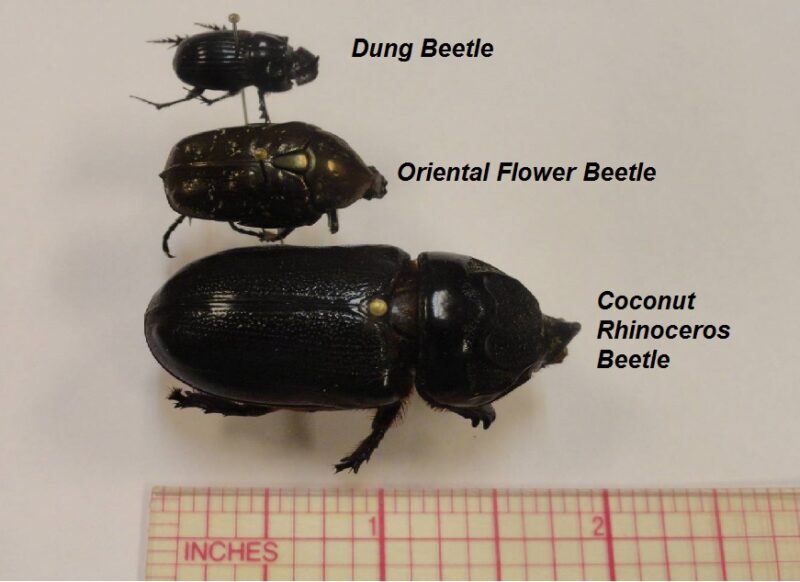
The coconut rhinoceros beetle (Oryctes rhinoceros) is an invasive insect species that poses a serious threat to palm trees and other vegetation in Hawai’i. Native to Southeast Asia, the beetle has spread throughout the Pacific, including Guam and Hawai’i, largely due to human activity and the movement of organic materials (Paudel et al.). It was first detected on O’ahu in 2013, where it was found breeding in green waste such as compost piles and coconut tree trimmings (Hara et al.). The adult beetle damages trees by boring into the crown of the palm tree to feed on the sap, which can weaken or even kill the tree over time. In addition, the larvae develop in decaying organic matter, including dead trees, mulch, potted plants, and potting mix, making improperly managed green waste a key factor in the beetle’s spread. These characteristics make the coconut rhinoceros beetle particularly difficult to control, as both its life cycle and its movement are closely tied to human behavior and environmental conditions. More recently, the spread of the coconut rhinoceros beetle has expanded beyond O’ahu, with detections reported on the Big Island, Kaua’i and Maui as of 2023 (CRB Response Program). This expansion highlights the ongoing challenge of preventing inter-island spread and reinforces the importance of monitoring and control efforts.
The spread of the coconut rhinoceros beetle can be better understood through a Systems Ecology perspective, which emphasizes the interconnected relationships between human activity and environmental processes. Initially, I assumed that the black panel traps commonly seen hanging on trees around O’ahu were designed to control the beetle population. However, I later learned that these traps are primarily used for monitoring rather than eliminating the beetles, highlighting the complexity of managing invasive species. The beetle’s life cycle is closely tied to human behavior, particularly the accumulation and improper disposal of green waste, which provides ideal breeding conditions for larvae (Hara et al.). In addition, adult beetles are capable of flying significant distances, with reports suggesting they can travel up to two miles in a single day, allowing infestations to spread rapidly between properties and communities. As a result, effective management depends not only on individual efforts but also on coordinated action across neighborhoods. Even if some property owners actively remove breeding materials and treat affected trees, the presence of unmanaged organic waste or infested material nearby can undermine these efforts. Guidance from the Hawaii Invasive Species Council also emphasizes the importance of properly disposing of infested green waste and compost to prevent further spread (Hawai’i Invasive Species Council). However, because these practices are not strictly enforced by law, their effectiveness depends heavily on voluntary participation by the community. This highlights a key challenge in managing the beetle, as even well-informed individuals can be impacted by the actions of others who may not follow recommended practices. This interconnected system demonstrates how both ecological and human factors contribute to the persistence and spread of the coconut rhinoceros beetle.
The management of the coconut rhinoceros beetle also raises important questions within Environmental Ethics, particularly regarding the use of chemical treatments. One method involves injecting insecticides directly into palm trees or around the base of the tree to prevent further damage. While this approach can be effective in protecting individual trees and slowing the spread of the beetle, it also introduces potential risks to surrounding ecosystems. There are concerns about how these chemicals may affect soil health, water systems, and non-target species, especially in sensitive isolated island environments like Hawai’i. This creates a difficult trade-off between protecting culturally important plants such as kalo, hala, and other native species, and potentially harming other organisms within the ecosystem. In Braiding Sweetgrass, Robin Wall Kimmerer discusses the impact of the emerald ash borer, an invasive species from Asia that has devastated ash tree populations in North America. This example parallels the coconut rhinoceros beetle in Hawai’i, highlighting how invasive species introduced through human activity can rapidly disrupt ecosystems and raise questions about human responsibility in preventing further environmental harm. In one of the Hawai’i Invasive Species Council update, it is noted that federal agencies are closely monitoring Hawai’i’s response, as the islands are considered the most likely pathway for the beetle to spread to the continental United States. Additionally, recent environmental events, such as the heavy flooding from the Kona low storms, have shown how chemicals and debris can be carried through living areas and into waterways and the ocean, raising further concerns about contamination and risks to both human and wildlife health. These factors highlight the complexity of managing the coconut rhinoceros beetle, where solutions aimed at addressing one problem may unintentionally create new environmental challenges. As a result, managing the beetle requires careful consideration of both effectiveness and environmental responsibility, balancing the need for immediate intervention with long-term ecological sustainability.
Current efforts to manage the coconut rhinoceros beetle involve a combination of strategies, each with its own strengths and limitations. Sanitation, which includes removing breeding materials such as green waste, dead trees, and decaying organic matter, is considered one of the most effective methods for reducing beetle populations, although it is labor-intensive and requires consistent community participation. Insecticide treatments can provide fast and reliable protection for individual trees, but they are not a sustainable long-term solution. In many cases, these treatments rely on the beetle feeding on the tree in order to be exposed to the chemical, meaning that some level of damage may still occur before the treatment is effective. In addition, while these chemicals often come with recommended application guidelines, they can be difficult to follow consistently, and improper or excessive use may pose risks to the surrounding environment. This highlights another challenge in coconut rhinoceros beetle management, where individual misuse can reduce effectiveness and contribute to unintended environmental harm. Biological control methods, such as the use of pathogens or other natural agents, offer the potential for long-term suppression, but these approaches are still being researched and are not yet widely available. For example, techniques similar to sterilization methods used in mosquito control have been explored, but they require extensive development before they can be applied effectively to the coconut rhinoceros beetle. While natural predators may contribute to reducing beetle populations, their impact is limited because they often remain near the surface and may not reach the beetle’s primary breeding sites within decaying organic material. Traps are widely used for monitoring beetle presence and detecting early infestations, but they are not effective as a standalone control method. Additional approaches, including physical removal and protective netting, may help in localized situations, but they require frequent monitoring to ensure they remain secure and effective. This can be particularly difficult for taller trees, where maintenance and access are more challenging. Together, these strategies demonstrate that no single solution is sufficient, and that managing the coconut rhinoceros beetle requires an integrated and coordinated approach.
Efforts to address the coconut rhinoceros beetle involve both nonprofit and private sector participation, each contributing different approaches to the problem. The CRB Response Program, supported by agencies such as the Hawai’i Invasive Species Council, focuses on monitoring, public education, sanitation efforts, and preventing the spread of the beetle between islands. These programs emphasize community awareness and cooperation, recognizing that long-term success depends on widespread participation rather than isolated actions. However, despite these efforts, challenges remain due to limited enforcement and reliance on voluntary compliance. In contrast, private companies such as Aloha Tree Savers offer treatment options aimed at protecting individual trees, often through chemical or specialized applications. While these services may provide immediate and localized results, they also raise important questions regarding transparency, cost, and scalability. For example, limited publicly available information about the composition and efficacy of these treatments makes it difficult to evaluate their broader environmental impact. Additionally, if such methods are highly effective, it is unclear why they have not been more widely adopted in other heavily affected regions such as Guam. Currently the CRB Response website has information for traps and netting, but information regarding pesticides and other treatment methods is still listed as “coming soon,” suggesting that further testing and research may be ongoing before releasing potentially inaccurate or incomplete information. This suggests potential limitations, including cost, accessibility, or environmental concerns. Together, these examples highlight the need for greater coordination, transparency, and evaluation across both nonprofit and for-profit approaches in order to develop more effective and sustainable long-term solutions.
Reflecting on the impacts of the coconut rhinoceros beetle and the complexity of managing it, I recognize the importance of applying environmental ethics to my own actions. One of the most immediate steps I can take is to be more aware of how green waste is managed, ensuring that plant material is properly disposed of and does not contribute to potential breeding sites. I occasionally volunteer in community cleanups, most recently due to the Kona low storms, which reinforces the importance of removing debris and organic waste that could serve as breeding grounds for invasive species like the coconut rhinoceros beetle. I also plan on staying informed about updates from the CRB Response Program and local organizations, and to share accurate information with others in my community to help raise awareness. As a photographer who frequently works in outdoor environments, as well as a frequent beachgoer, I have become more aware of the condition of the landscapes I interact with. This has encouraged me to pay closer attention to signs of environmental change, such as the decline of palm trees, and to be more intentional about how I engage with these spaces. I will also be more mindful of the products and methods used to manage pests, considering both their effectiveness and their potential environmental impact. More broadly, this issue has changed how I view environmental problems, emphasizing that individual actions are connected to larger systems and that meaningful progress requires cooperation and communication within the community. By taking these steps, I can contribute in a small but meaningful way to addressing the spread of the coconut rhinoceros beetle and protecting Hawai’i’s ecosystems.
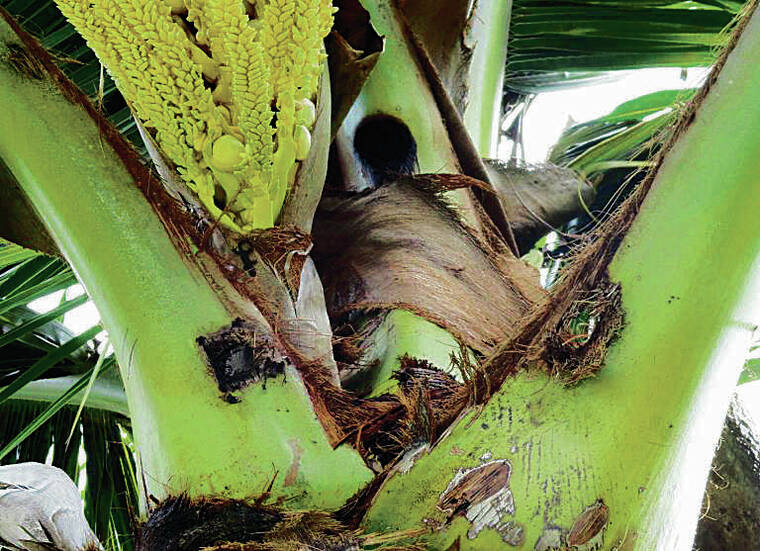
Image Sources: Honolulu Star Advertiser (above) and O’ahu Invasive Species Committee (article cover)
Troy Kohatsu is a UHM student, majoring in Interdisciplinary Studies. He wrote this paper for a course entitled Human Values and the Environment taught by HTMC member Betsy Fisher. He recently shifted his academic focus toward environmental concerns after witnessing impacts internationally and learning through cultural perspectives, recognizing that Hawai’i is particularly vulnerable to environmental threats.
Aloha Tree Savers. Aloha Tree Savers. https://www.alohatreesavers.com
CRB Response Program. Coconut Rhinoceros Beetle Response. https://www.crbhawaii.org
Hara, A.H., et al. Palm Pest Alert: Coconut Rhinoceros Beetle Oryctes rhinoceros. University of Hawaii at Manoa, CTAHR, 2014.
Hawai’i Invasive Species Council. 10th year of the Coconut Rhinoceros Beetle- How did we get here and where do we go?. YouTube, 2023, https://www.youtube.com/watch?v=JK_hqX1Tx9E
Hawai’i Invasive Species Council. Battling the Beetle: Exploring new tools and technologies for combating CRB in Hawai’i. YouTube, 2024, https://www.youtube.com/watch?v=Hu-7JZo3IqM
Kimmerer, Robin Wall. Braiding Sweetgrass: Indigenous Wisdom, Scientific Knowledge, and the Teachings of Plants. Milkweed Editions, 2013.
Paudel, Sulav, et al. “Can Biological Control Overcome the Threat From Newly Invasive Coconut Rhinoceros Beetle Populations.” Annals of the Entomological Society of America, 2021.
United States Department of Agriculture. Coconut Rhinoceros Beetle Response Program on Oahu: Environmental Assessment. USDA, 2014.